 PlacerPro
Gold panning in Washington
Where to pan for gold in Washington, the official public panning areas, and the rules for each kind of land. Our map of Washington draws on 8,417 gold records: old mines, prospects, placer claims and lab-tested stream samples.
The short answer: The areas of Washington with the most gold records in our data are the west Cascades; Skamania, Yakima and nearby counties; Okanogan, Ferry, Stevens and Pend Oreille; and Chelan and Kittitas. We haven't found an officially designated public panning area here yet, so check who owns the land first. To pan legally, you need open public land that isn't under a mining claim, or the owner's permission.
Washington on the map
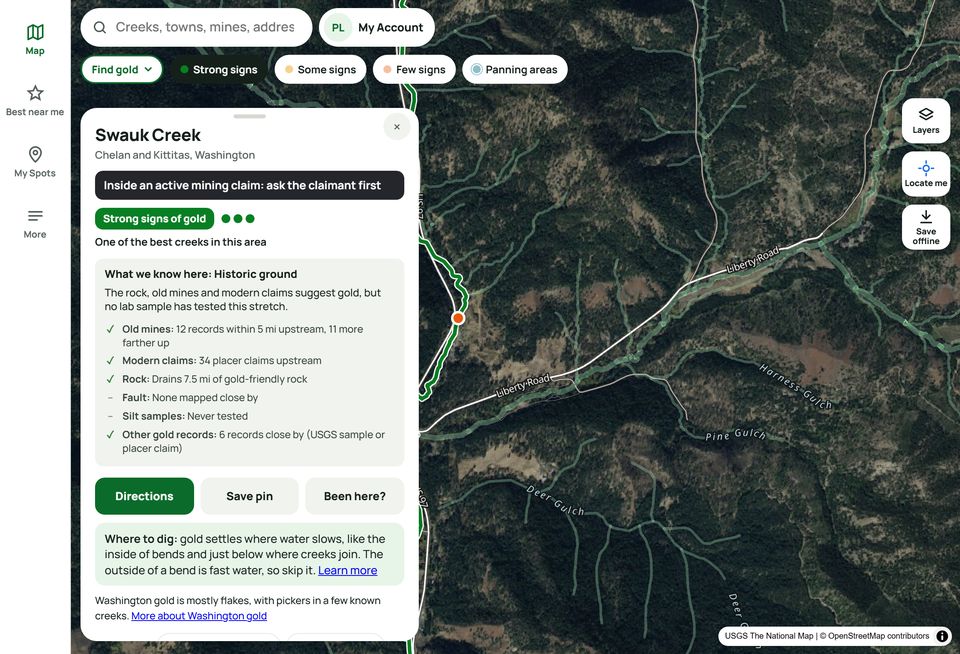
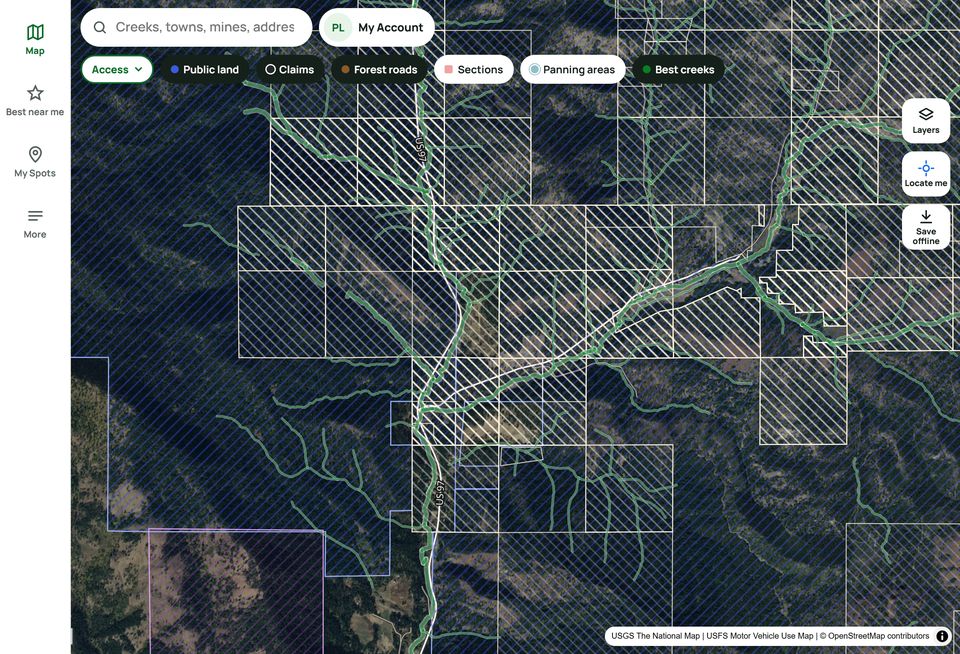
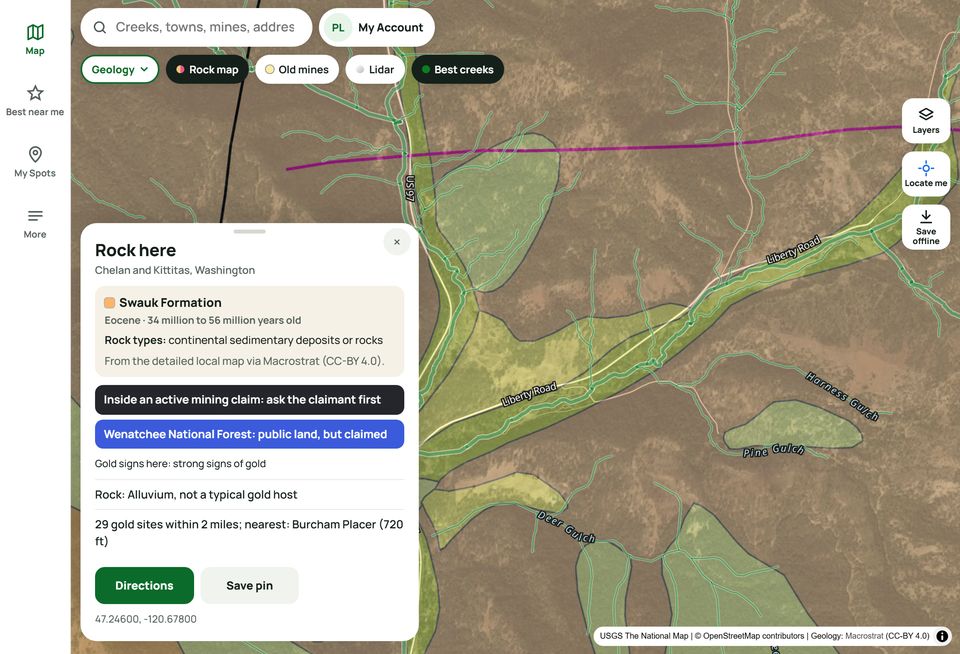
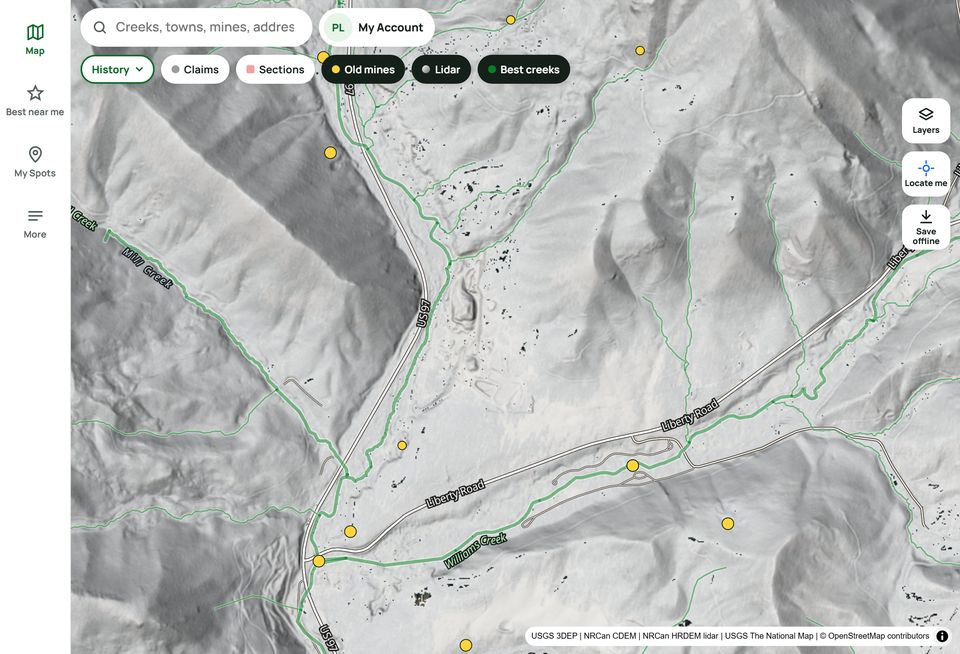
PlacerPro at Liberty and Swauk Creek, Washington.
Gold areas in Washington
PlacerPro covers Washington's known gold country:
- Asotin County
- Chelan and Kittitas (Liberty, Swauk Creek, Blewett, Peshastin)
- Clallam County
- Douglas County
- Grays Harbor County
- Okanogan, Ferry, Stevens and Pend Oreille (Republic, Similkameen, Columbia River bars)
- Skamania, Yakima, Pierce, Clark, Benton, Grant and Lincoln counties
- West Cascades (Snohomish, King, Skagit, Whatcom: Sultan, Monte Cristo, Mount Baker)
Try the Washington map free for 7 days
Where to dig once you're on the creek
Even on a good creek, most of the gravel holds little. Gold settles where the water slows: the inside of bends, just below where creeks join, behind boulders, and down in bedrock cracks. Read the beginner's guide to where gold settles.
Gold panning rules in Washington
- National Forest and BLM land: recreational panning with hand tools is generally allowed unless the ground is claimed, withdrawn or posted. Check with the ranger district or BLM field office.
- Active mining claims belong to the claimant: don't prospect on them without permission. BLM maps claims to survey sections, so outlines are approximate; check claim posts on the ground.
- Wilderness: closed to new claims and to motorized or mechanized equipment.
- Washington state land: placer mining is not allowed on DNR State Trust Lands. To prospect, mine or metal-detect on state-owned riverbeds (navigable rivers below high water), work with DNR's Aquatic Resources Division first. WDFW wildlife areas need WDFW permission and a land use permit.
- Washington hand work: WDFW's Gold and Fish pamphlet (2021) is your permit. Year-round in streams (not lakes) you may use pans and small non-motorized sluices or mini rockers, in daylight, digging only outside the water. Digging in the stream itself, with sluices, rocker boxes or non-motorized highbankers, is allowed only in each water's work window listed in the pamphlet, with the pamphlet on site.
- Motorized and gravity-siphon mining (suction dredges and other motorized gear): banned since June 2020 in critical habitat for salmon, steelhead and bull trout and in salmon spawning and rearing waters (ESHB 1261). Elsewhere it needs a written HPA from WDFW plus an individual Ecology water-quality permit (apply at least 180 days ahead).
Common questions
Where can I pan for gold in Washington for free?
We haven't found an officially designated public panning area in Washington yet. Panning is usually allowed on open public land (national forest and BLM) that isn't covered by a mining claim, and on private land with the owner's permission.
Do I need a permit to pan for gold in Washington?
Hand panning usually needs no permit on open public land, but the rules depend on who manages the land and what tools you use. Sluices, highbankers and dredges often need permits. The rules for Washington are below.
How do I find gold-bearing creeks in Washington?
Gold washes downstream from where it eroded out of the rock, so the best creeks drain old mining districts and gold-bearing rock. PlacerPro rates every creek in Washington's gold country from old mine records, USGS lab samples and geologic maps, and shows public land and active claims.
Other places
- Gold panning in Alabama
- Gold panning in Alaska
- Gold panning in Arizona
- Gold panning in British Columbia
- Gold panning in California
- Gold panning in Colorado
- Gold panning in Georgia
- Gold panning in Idaho
- Gold panning in Maine
- Gold panning in Montana
- Gold panning in Nevada
- Gold panning in New Hampshire
- Gold panning in New Mexico
- Gold panning in North Carolina
- Gold panning in Oregon
- Gold panning in South Carolina
- Gold panning in South Dakota
- Gold panning in Tennessee
- Gold panning in Utah
- Gold panning in Vermont
- Gold panning in Virginia
- Gold panning in Wyoming
- Gold panning in Yukon
PlacerPro rates every creek in the gold country of 22 US states, British Columbia and Yukon from old mine records, lab samples and geologic maps. Public panning areas are from official agency sources; check the linked source before you go. Nothing here is legal advice.